Estonian drift championship (Pro2) · 2026
Drift championship title calculator
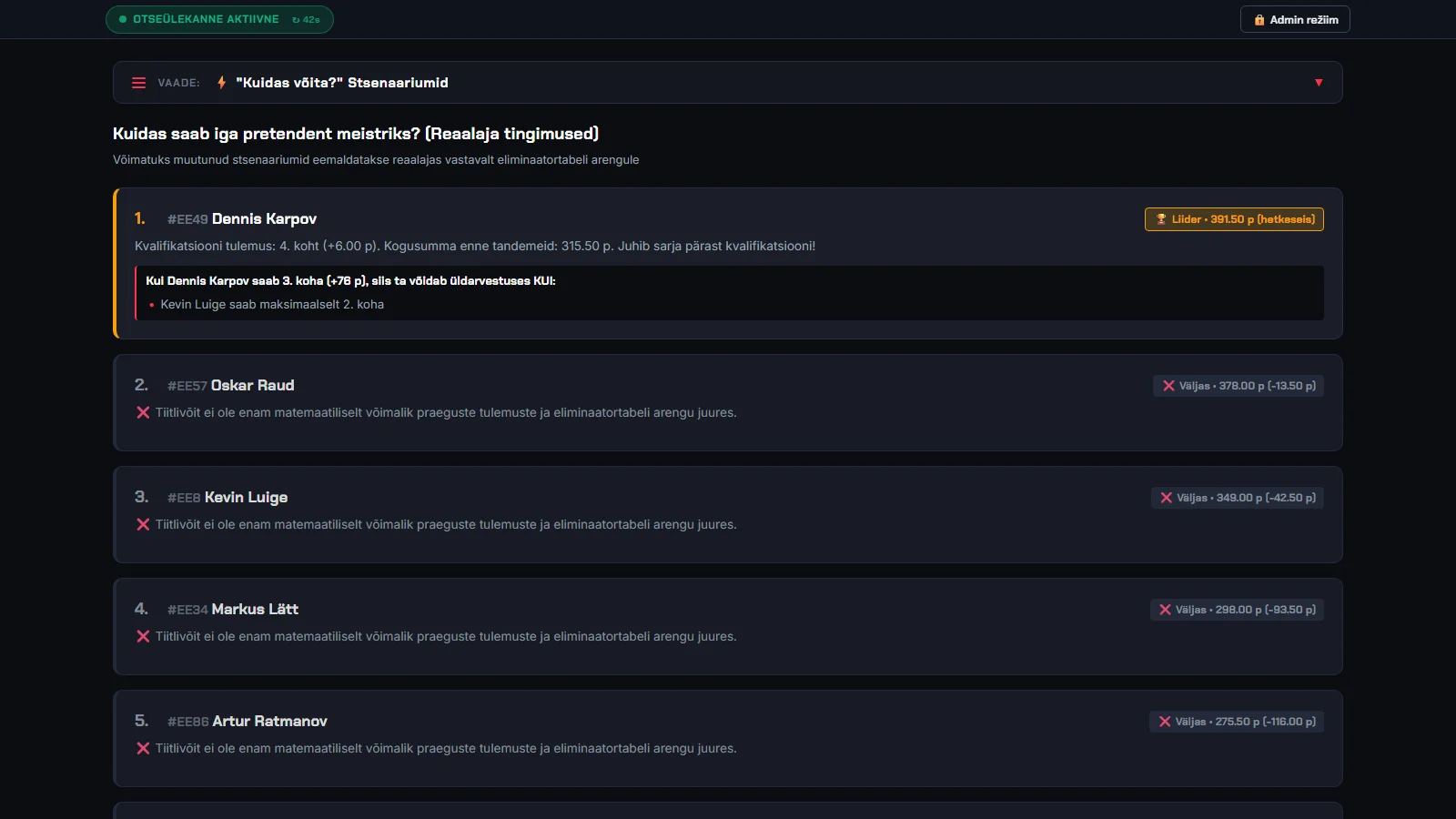
A live calculation of which of five title contenders can still win the championship in the final round, and with what result.
Goal
Going into the championship's deciding final round, five drivers were close together on points. The official results service shows the run results, but not what they mean: who can still become champion, with what result, and how it affects the others. That had to be visible live, on every viewer's screen at the same time.
Results in numbers
What changed
25
registered drivers in the finals
5
title contenders before the deciding round
32
place elimination bracket
5 s
between result updates during qualifying
The situation
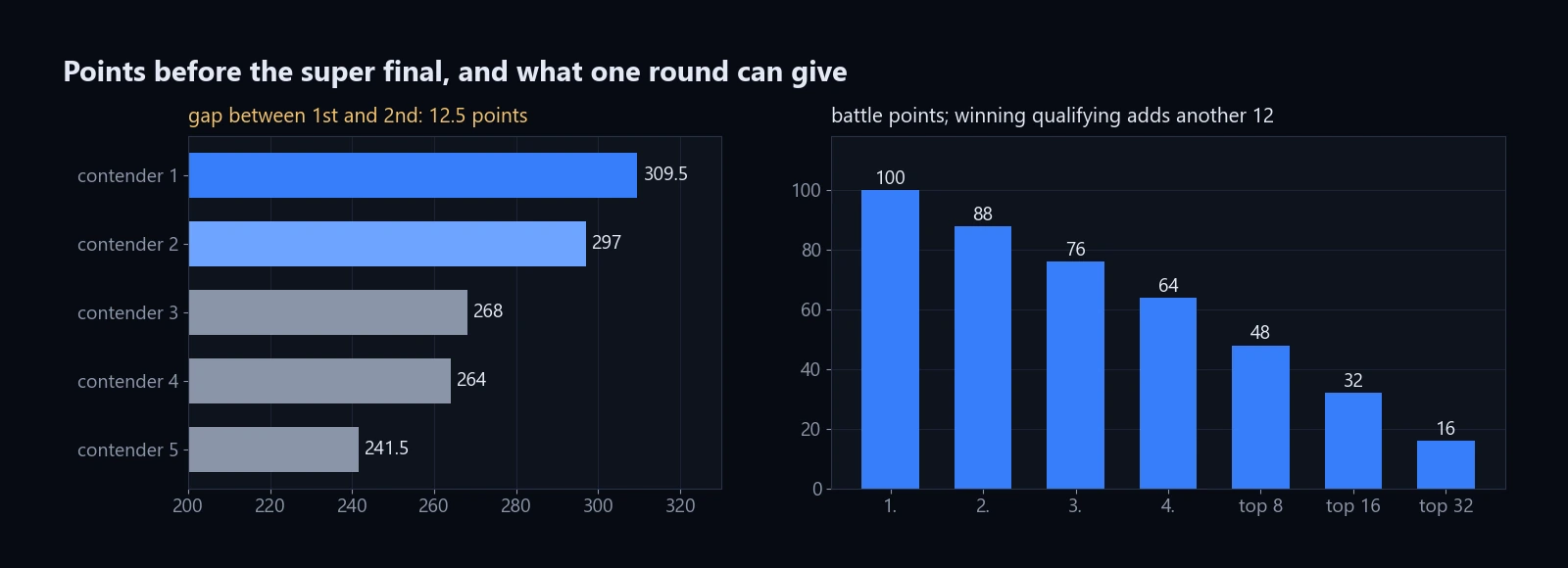
Going into the super final, the Estonian drift championship standings were very tight. Five drivers were fighting for the title: 309.5, 297, 268, 264 and 241.5 points. The 12.5-point gap between first and second was almost exactly what a qualifying win is worth. One good or bad run could flip the whole picture.
The official results service (DriftPoint) shows qualifying and battle results as they happen, but not what they mean for the title. Who can still become champion? With what result? And what happens if someone else knocks them out first? Drivers and spectators used to work this out in their heads, often wrongly.
I built a live calculation alongside it that answers those questions after every run, on every screen at once. The harder part than adding up points was that the results service’s data isn’t always ready, unambiguous or right. Each problem below also says what didn’t work the first time.
Constraints
- The points rules (qualifying, battles and a multi-step tie-break) had to be tied to results data that doesn't calculate the championship itself.
- The result had to update on every viewer's screen at once, without anyone refreshing the page.
- The results service must not be overloaded, no matter how many people are watching.
- Everything had to run on an ordinary web server, without a database.
- No driver could be calculated alone. Each contender's chances depend on what the other four do at the same time.
Solution
How I solved it
Rules
How do you turn the championship points system into a calculation that actually works?
The points tables come straight from the 2026 rulebook. Qualifying gives 12, 10, 8, 6 and so on down to 0.1 points. From the battles the winner gets 100, second 88, third 76, fourth 64, the Top 8 48, the Top 16 32 and a first-round exit 16 points.
On equal points the drivers are compared step by step: first event wins, then second places and so on down to 32nd. If that still doesn’t decide it, the result of the season’s last event counts. The calculation uses the same logic when it needs to know whether a tie would give someone the title. On paper it’s a simple table, but every scenario runs through it, so it has to be written exactly as in the rulebook, not “roughly like that”.
Qualifying
The qualifying order decides who meets whom in the battles. It had to be right before the results service published it.
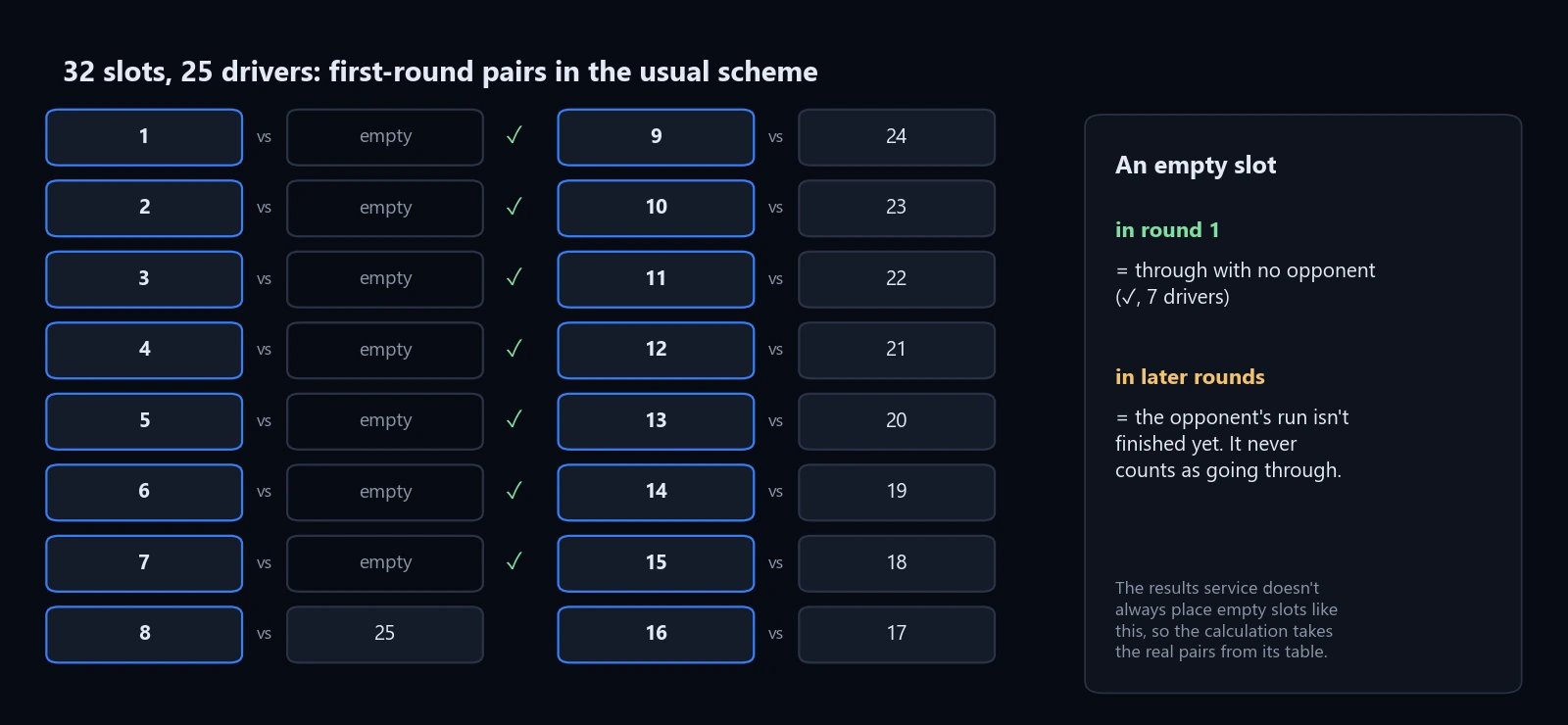
A qualifying position doesn’t only give points. It also sets the pairs: first rides against 32nd, second against 31st and so on. If the order is wrong, every scenario after it is wrong too.
The rulebook sorts in nine steps: best run, the sum of both runs, the best run’s line, angle and style, then the weaker run’s line, angle and style, and finally the lower car number. The calculation does this itself from the raw run scores after every new run, so the order is right during qualifying already.
Data matching
The results service identifies drivers by name, and names are written slightly differently (accents, upper and lower case, punctuation).
Before comparing, every name is normalised: accented letters become plain letters and punctuation is removed. If a driver isn’t found in the list, they’re added automatically and their season points so far are taken from the same service. That way nobody starts from zero when they actually already have points.
There was a trap here too. The results service adds an event’s points to the season total only after the event ends. If a driver found later had their points taken during the event and again after it, the same event would have counted twice. Now the ongoing event is left out of the season points until it’s over.
Bug fix
The calculation gave a driver who never entered the event 16 points for the first round.
What didn’t work: the simulation state still held the battle bracket from an earlier calculation. That driver was in the Top 32 there, and the calculation gave them the points for it even though they weren’t at the real event. A small bug, but exactly the kind that can decide a title wrongly.
How it works now: only drivers actually entered in the event score points. The pairs are rebuilt every time from the current qualifying, not taken from old state. Old state can no longer leak into a new calculation.
Bracket
In the bracket an empty slot can mean two very different things: the opponent isn't known yet, or nobody is in that slot at all.
There were 25 entrants and 32 slots in the bracket. So in the first round some drivers go through without an opponent. An empty slot counts as a walkover only in the first round, where that can really happen. In later rounds an empty slot means the opponent’s battle is still running. The system must never count that as a walkover, or someone would get a win they haven’t earned yet.
Second surprise: the results service doesn’t always place walkovers by the usual scheme (first against 32nd, second against 31st). So the calculation doesn’t guess the pairs, it takes the actual pairing from the results service’s bracket.
Scenarios
How do you show not just the current standings but every situation in which each of the five contenders could become champion?
For each contender and each possible final result, the system works out how far the other four can get for that situation to still hold. That becomes a plain sentence, for example “becomes champion with 3rd place IF rival A doesn’t get past 2nd AND rival B goes out earlier”.
The list gets shorter as the event goes on. Once a rival is in the Top 8, every scenario that needed them out earlier disappears straight away. Viewers only ever see the options that are still genuinely open.
Outsiders
The super final can also be won by someone outside the five. That changes the title maths too.
The other 20 drivers can’t become champion, but they take places and points from the contenders. A separate block shows what happens if one of them wins the super final or takes a podium: which contenders gain and which lose. This was often the most interesting part, because an outsider’s win could decide the title more than the contenders’ own battles.
Live updates
Dozens of people watch the same result at once. How do you keep every screen in sync without overloading the server or the results service?
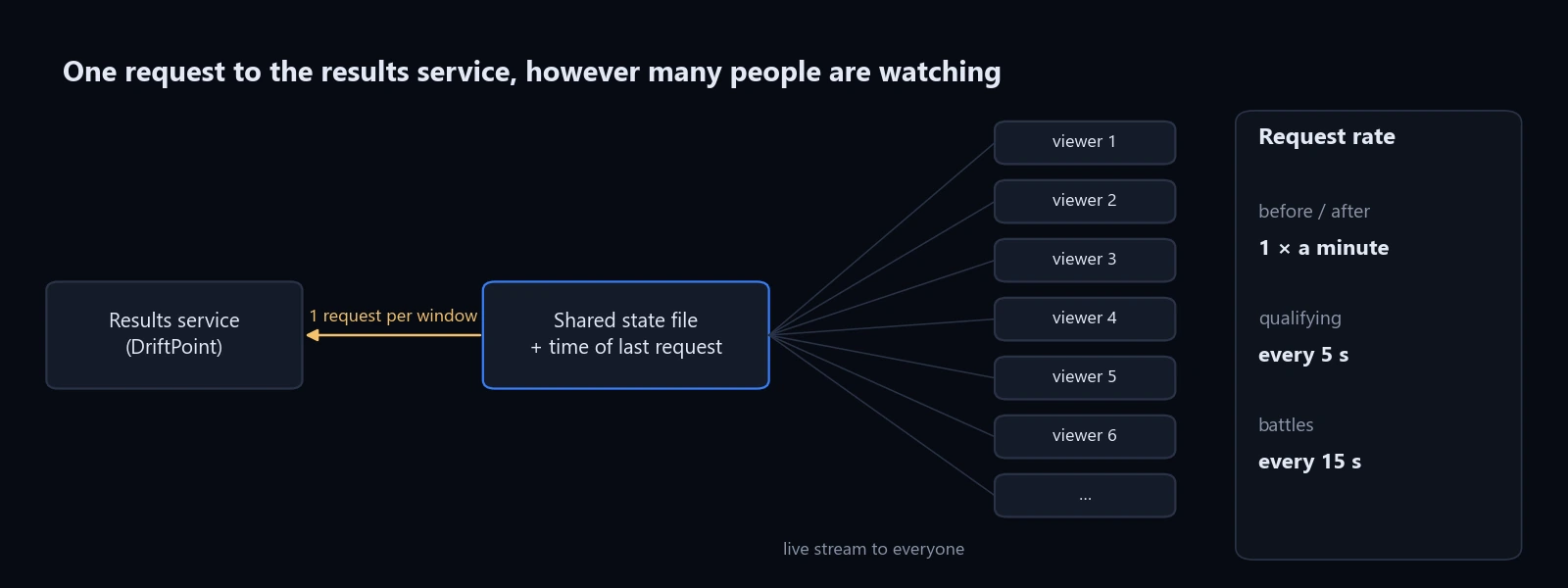
All viewers get updates as a live stream from one shared state file. The results service is asked for data only once per time window, however many people are watching: the state file holds the time of the last request and every viewer sees it.
How often it asks depends on the stage of the event. Once a minute before the start and after the end. Every 5 seconds during qualifying, as often as the results service’s own broadcast graphics. Every 15 seconds during battles, because a pair runs for several minutes.
What didn’t work: the development server handles one request at a time. An open live stream held it up and everything else had to wait. Now the server sends the current state straight away and closes the connection, and the browser reconnects on its own. To the viewer it still looks like a live stream.
Control
What happens when the results service publishes a wrong result?
It happens: judges correct scores and in the meantime the screen shows the wrong standings. The organiser can pause automatic updates with one click and correct the standings by hand. While updates are paused, no new request overwrites the manual correction. Only checked results reach the screens.
The organiser’s changes don’t go out to everyone at once either. A manual fix or a chosen battle winner first stays on the organiser’s own screen in test mode, where they can see what it does to the standings and scenarios. Only the “Send to everyone” button pushes that state to every viewer’s screen. So spectators never see a half-finished or mis-clicked state.
Result
During the super finals, drivers, teams and spectators saw live what result would win the title at any moment and whose result affected whose chances. Nobody had to work out the points table in their head. The organiser was in control throughout: every standing on screen had been checked and was right.
The whole system is a couple of PHP files and one state file. It needs no database, no separate server and no paid services.
What's next
The logical next step is to use the same calculation for other classes and events, not just the super finals.