Service
Cloud, DevOps & Performance
Infrastructure that doesn't wake you up at 3am.

Migrations to cloud providers, Docker containerisation, CI/CD pipelines with automated tests, and SLA-based maintenance: incident response, security updates, backups and autoscaling.
Plus analysis and fixes for slow database queries, code bottlenecks and server load, including Core Web Vitals.
- Cloud migration plan and execution with zero downtime
- Docker containerisation for the app and its services
- CI/CD pipeline with automated tests and deploy gates
- SLA agreement with response times and responsibilities
- Backup and disaster-recovery setup, tested end to end
- Performance audit: database, backend, frontend, infrastructure
- Database query optimisation with an index review
- Core Web Vitals fixes (LCP, CLS, INP)
- Before/after report with concrete metrics
Examples
Typical situations and how I'd handle them
SaaS startup
Deploys without fear
Problem
Releases are manual and overnight outages are only noticed in the morning.
Solution
CI/CD, containers, monitoring and alerts, plus backups whose restore has actually been tested.
Result
A new version is live in minutes and you hear about failures before your customers do.
Online shop on shared hosting
A site that survives the campaign
Problem
On the big campaign day the site goes down, exactly when customers arrive.
Solution
A move to a proper server, caching and a load test before the campaign.
Result
Your best sales day doesn't turn into your worst.
What's included
What I do as part of this service
Zero-downtime migration to a new cloud
AWS, Google Cloud, DigitalOcean or Hetzner: planned so users don't notice the switch.
CI/CD that blocks broken deploys
GitHub Actions/GitLab CI with automated tests before anything reaches production.
SLA maintenance with a real response time
Incidents, security updates and backups on a schedule, not “whenever there's time”.
Docker containerisation built for the load
Your app packaged to run identically locally and in production.
Autoscaling for traffic spikes
Infrastructure that grows with load and scales back down, without manual intervention.
Database query analysis and optimisation
Slow queries found through profiling, not guessing, and fixed with indexing and rewrites.
Core Web Vitals into the green
LCP, CLS and INP fixed measurably, not just cosmetically for the Lighthouse score.
Lower server load without adding hardware
Caching, fewer queries and code optimisation before we even consider a bigger server.
A before/after report with real numbers
Every optimisation documented with a measurable result: load time, query count, server load.
FAQ
Frequently asked questions
What's a typical SLA response time?
Critical incidents usually within a few hours, routine maintenance requests within 1–2 working days. We agree the exact terms in the contract.
Is migration done with zero downtime?
The goal is always minimal or no user-visible interruption: the plan includes running in parallel and a rollback path if something goes wrong.
Do we have to switch hosting providers?
Not necessarily. I can optimise your existing infrastructure if a switch isn’t needed or economically sensible.
How do you measure “twice as fast”?
With concrete metrics: page load time, database query duration, server response time, measured before and after under the same conditions.
Does optimisation require rewriting the code?
Usually not. Most bottlenecks go away with targeted changes: indexes, caching and fewer queries.
Does this work if we don't know what exactly is slow?
That's exactly what it's for: I measure first to find the bottlenecks, and only then we decide what to fix.
Work
Related work
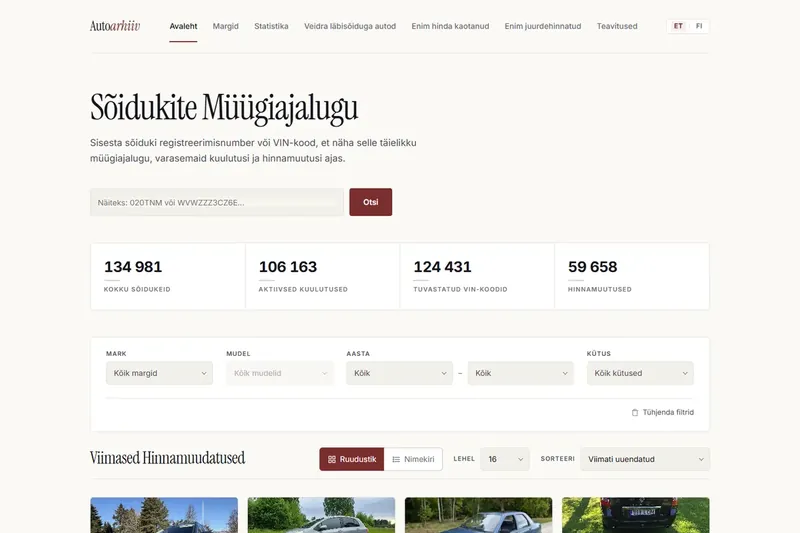
Autoarhiiv.ee
Websites & WordPress

Production planning list
Automation, APIs & Payments